

Termite Control: How to Get Rid of Termites with Effective DIY Treatment Solutions
As far as pests go, termites are some of the worst for your home. They can damage a structure’s integrity, decrease the selling value, and cause health hazards. While they’re difficult to spot and eradicate, there are ways to get rid of them for good!

Let’s Talk Termites
The most common termite in Arizona is the desert subterranean termite, which is about 3/8" long, including their wings. Their body is a pale yellowish brown, with a rectangular head, and their body is flat and almost as wide as the head.
Drywood termites are slightly larger than the subterranean termites, and although they are not as common, they definitely do more damage when left untreated. These are the pests that result in expensive treatments and whole houses being tented, because they actually build their colonies within the very wood structure they inhabit.
How to Get Rid of Termites in Arizona
Termite control with a granule termiticide often costs as little as $20 per year for a 2,000 square-foot home! This odorless concentrate acts like a bait: the termite picks up the chemical, does not realize he has picked it up, takes it back to the termite colony, and ultimately destroys the colony.
How to Control Existing Termites
The process is easy, and the products are safe around pets and children, do not injure the ground water table, and are virtually odorless. Best of all, they last up to nine years.
First, fix any water leaks (e.g., hose bibs, condensate lines) and get rid of any water that collects (e.g., puddles next to house). Then create a barrier against termites by: Tap or click on the arrows to see more.
Create a Barrier
Digging a trench 6" deep by 6" wide around the perimeter of your house
Clear Hiding Places
Pouring the termiticide into the trench
Get Help from a Pro
Adding the backfill dirt back into the trench on top of the termiticide
Desert Subterranean Termites
The desert subterranean termite thrives in high-temperature, low-humidity climates, so the arid Sonoran Desert is perfectly suited to them. These common termites live in underground colonies where moisture is prevalent and number up to 300,000, but they also live in desert plants like dead cactus. They build distinctive mud tubes to gain access to food sources and to protect themselves from the open air. Although termites are like water, desert subterranean termites are less dependent on moisture and decay than other subterranean termites.
Termite colonies are organized into castes depending on tasks: workers, soldiers and reproductives. Cream-colored worker subterranean termites are 1/8 to 3/8 of an inch in length. Soldier subterranean termites are of a similar body length, but are distinguished by their powerful mandibles. Solider termites have cream-colored bodies and brown heads. Reproductive subterranean termites are approximately one inch long.
How to Know if You Have Termites
Mud tunnels on your house probably mean you have termites, but if you're not sure whether you actually have termite activity, bring in a picture of what you see to any one of our Valley-wide stores, and we will show you how to get rid of termites in Arizona!
In general, the larger the mud tunnel, the greater the termite activity. For example, a mud tunnel measuring about a nickel in width suggests many months or even a few years of activity. So, the earlier you observe their damage, the sooner you can prevent further spread.
Another sign of subterranean termites is evidence of these tunnels on cardboard boxes, often in the garage. Many people who moved to Arizona from other parts of the country use their garages to store boxes, and termites also like boxes. Especially if those boxes are seldom moved or disturbed, the termites can quickly and quietly infest a home through the cardboard boxes.
For effective termite control in Phoenix, Gilbert, Mesa, or Tempe, Arizona, Bug & Weed Mart has the DIY solutions you need to protect your home. Our expert advice and professional-grade products ensure a comprehensive termite prevention and treatment approach.
Customer Reviews
Choosing Pest Products from a Company that Knows How to Get Rid of Termites
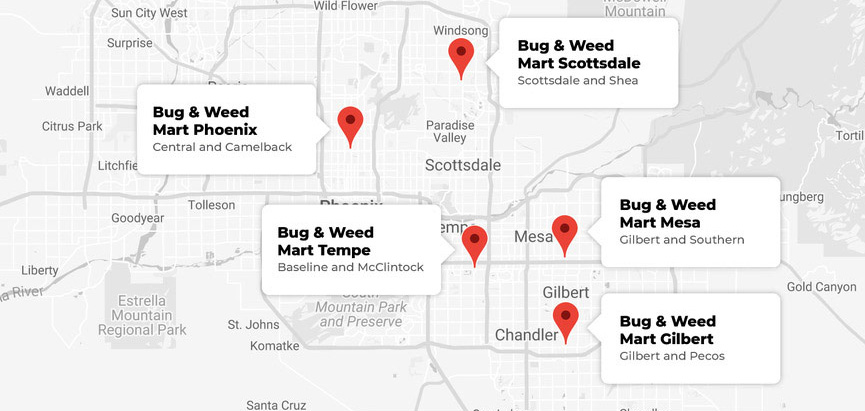
Bug & Weed Mart has several locations around the Phoenix metro area where we sell the products that can help you get rid of termites.
Related Articles

Flying Ants vs. Termites: What’s the Difference?